
NJ plumbing & heating guide
Preventing Frozen Pipes in Older NJ Homes
How to prevent frozen pipes in NJ's older homes, insulation, exposed runs and cold-snap habits. Read the licensed-plumber guide.
Licensed NJ Master Plumber #13345 · 4.9★ (294 Google reviews)
By Morey Katzourin · NJ Master Plumber License #13345· Bonded & insured
Here is how to prevent frozen pipes in NJ before the first hard freeze. Insulate the exposed runs in your basement and crawl space, disconnect the garden hoses, know where your main shut-off is, and on the coldest nights, let the right faucet drip. That last part trips people up. In a pre-1970 West Orange colonial with plumbing strung along exterior walls and aging galvanized supply lines, the pipe that bursts is almost never the one that freezes hardest. It is the closed section between the ice and a shut faucet, where the pressure has nowhere to go. Get that one detail right and you avoid most winter disasters. Get it wrong, and you find out at 2 a.m. If a pipe does let go, a licensed plumber answers 24-hour, Sunday to Friday.
How to Prevent Frozen Pipes in Older NJ Homes
Insulate exposed pipe runs, cut off and drain outdoor hose bibs, seal drafts near basement and crawl-space piping, keep the heat on even when you travel, and let the coldest exterior-wall faucet drip during a hard freeze. In older NJ homes with uninsulated basements and galvanized lines, prioritize the runs along outside walls and in unheated spaces, those freeze first.
That is the whole checklist in one breath. The rest of this guide explains why each step works, which parts of an older home actually fail, and what to do in the first ten minutes if a pipe freezes or bursts.
Why Older NJ Homes Freeze More Easily
Older NJ homes freeze faster because their plumbing runs through the coldest, least-protected parts of the house. The 1920s-to-1950s colonials and capes across West Orange, Montclair, and Maplewood were built before anyone worried about insulating a supply line. So you find copper and galvanized pipe tucked into uninsulated basement ceilings, threaded through vented crawl spaces, and buried in exterior wall cavities with almost nothing between the pipe and the outside air.
Northern NJ winters do the rest. The first sustained stretch below 20°F is when burst-pipe calls spike across Essex and Passaic counties. Water is at real risk of freezing once outdoor temperatures fall to about 20°F or below, especially in uninsulated or exterior-wall runs (American Red Cross. Insurance Institute for Business and Home Safety). A pipe on an interior wall in a heated room rarely gets there. A pipe in a crawl space with a broken vent screen and a January wind blowing through it hits 20°F fast.
Then there is the material problem specific to these houses. Plenty of older NJ homes still run on original galvanized steel supply lines that are now 60 to 100 years old. Galvanized corrodes from the inside, so the interior diameter narrows with rust and scale over the decades. A narrowed, weakened pipe splits more readily when the water inside it freezes and expands. If you have low upstairs pressure and rusty first-draw water on top of a freeze scare, the pipe is telling you something, and it is worth reading up on repiping old NJ homes and galvanized pipe before next winter.
Outdoor hose bibs are the other classic weak point. Many older NJ spigots are not frost-free, and people leave the hose attached all winter. The hose traps water against the valve, that water freezes, and the split shows up inside the wall behind it. It is one of the most common freeze failures we see, and one of the easiest to prevent.
Before Winter. Your Pre-Freeze Checklist
Do these before the first cold snap, not during it. Most cost little more than an afternoon and a trip to the hardware store.
- Insulate the exposed runs. Fit foam pipe sleeves over any accessible pipe in the basement, crawl space, garage, or along an exterior wall. The U.S. Department of Energy recommends insulating exposed hot- and cold-water pipes to cut heat loss and freeze risk (DOE Energy Saver). Prioritize the coldest, farthest runs.
- Disconnect and drain outdoor hoses, then cover the spigot. Pull every hose off, drain it, and fit an insulated faucet cover over each non-frost-free hose bib. If you have an interior shut-off for the outdoor line, close it and open the exterior spigot to drain.
- Seal the drafts. Crawl-space vents, basement window gaps, and the hole where the main line enters the house all let freezing air right onto your pipes. Close crawl-space vents for the season and seal obvious gaps with foam or weatherstripping.
- Find your main water shut-off now. It is usually where the line enters the basement, often near the water meter or on the street-side wall. Test that it turns. Finding it in the dark with water spraying is not the plan.
- Service the heat before you need it. A boiler that quits in a cold snap takes the whole house down to freezing in hours. Keep the heat running with a serviced boiler and do it in fall, not February.
- Add heat tape to the worst runs. For a pipe that has frozen before or sits in a genuinely cold spot, self-regulating heat tape rated for potable pipe is worth it. Follow the manufacturer's instructions exactly, heat tape misused is a fire risk.
- Open cabinet doors over exterior-wall plumbing. Kitchen and bath sinks on outside walls stay warmer if you let room heat reach the pipes under them. Simple, free, effective.
During a Cold Snap. What to Do When It's Below 20°F
When the forecast drops below 20°F, let the right faucet drip and keep the heat on, even in rooms you do not use. This is the part almost every guide gets half-right. They say "drip a faucet" and stop there, so people crack open a convenient bathroom tap on a warm interior wall and leave the vulnerable pipe untouched.
Here is the mechanism. Water expands roughly 9% as it freezes, and it is that expansion, not the cold itself, that bursts a pipe (a physical property of water. U.S. Department of Energy and building-science sources). When ice forms and grows in a run, it pushes water ahead of it. If that water can escape through an open faucet, pressure never builds. If it is trapped between the ice plug and a shut faucet, pressure climbs until the pipe gives, and it usually gives in that closed section, not at the ice.
So drip the faucet that sits at the end of the coldest, most exposed run, the one on the exterior wall, farthest from where the line enters the house. A slow, steady trickle is enough. That single relief point protects the whole run behind it.
A few more moves for the cold snap
- Keep the thermostat at one steady temperature day and night. Setting it back overnight to save a few dollars is a bad trade when it is 5°F out.
- Never let the heat off if you leave town. Set it no lower than about 55°F and, ideally, have someone check the house.
- Open interior doors so warm air circulates to the rooms with exterior-wall plumbing.
Frozen or burst pipe? Call now (908) 376-9159.
What to Do If a Pipe Freezes or Bursts
If a pipe bursts, shut the main off first, everything else is secondary. Move fast and in this order
- Shut off the main water valve you located earlier. This stops the flooding.
- Open a nearby faucet to relieve pressure and let the line drain.
- Kill the power to any area where water is near outlets or the panel. Do not stand in water to do it.
- Thaw gently if the pipe is only frozen, not split. Use a hair dryer, a space heater at a safe distance, or towels soaked in warm water, working from the faucet end back toward the freeze. Never use an open flame or a propane torch, that is how house fires and burst pipes both start.
- Call a licensed plumber. If a pipe has split, you need a repair, not a thaw. A 24-hour emergency plumber in NJ can find the break, fix it, and check the rest of the run.
If you cannot find the freeze, cannot get water back, or see any sign the pipe has already split, stop and call. Guessing on a burst line inside a finished wall gets expensive quickly.
When to Call a Licensed NJ Plumber
Call a licensed plumber the moment a pipe splits, when you cannot safely thaw a freeze, or when freeze scares keep happening in the same old lines. Maccabi Plumbing and Heating is a licensed NJ master plumber (License #13345), bonded and insured, answering 24-hour, Sunday to Friday, for burst-pipe and leaking-pipe emergencies. We are based at 300 Executive Drive in West Orange and serve 22 towns across Essex, Passaic, Morris, Bergen, and Union counties.
One honest note. If your freeze problem keeps coming back to the same aging galvanized runs, insulation and a dripping faucet are a bandage, not a cure. At that point, whole-house repiping galvanized to copper or PEX removes both the freeze vulnerability and the corrosion problem in one job. It is a bigger decision, and worth understanding before you commit, but it is the permanent fix.
Plenty of what is on this checklist you can handle yourself with a Saturday and a hardware run. The line between DIY and a call is simple. Prevention is yours, a split pipe is ours.
FAQ
Frequently asked questions
24-hour, Sun–Fri availability
Not seeing your question? Call or text and a licensed plumber will talk it through, no answering service run-around.
Call or Text (908) 376-9159Pipes are at real risk of freezing once outdoor temperatures reach about 20°F or below, per the American Red Cross. It happens sooner for uninsulated pipes on exterior walls, in crawl spaces, or in the unheated basements common in older NJ homes. During NJ cold snaps, insulate exposed runs and let a cold-side faucet drip to relieve pressure.
Keep reading
More NJ plumbing & heating guides
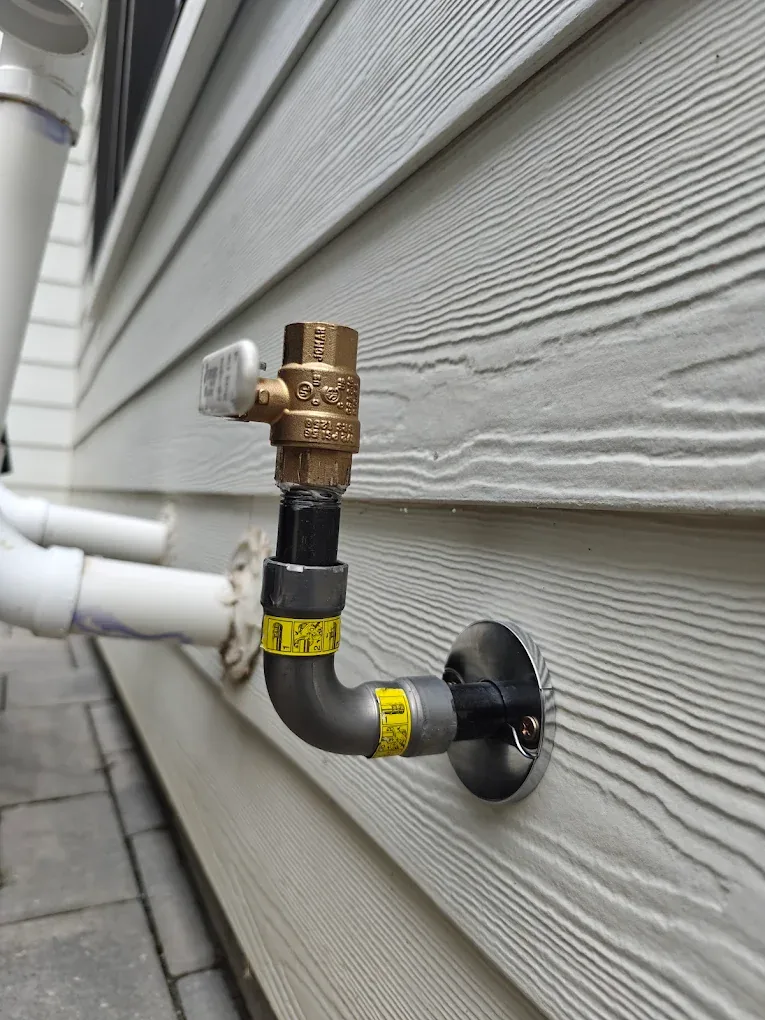
What Is Backflow Testing? NJ Rules Explained
Backflow testing explained for NJ. Who must test, the annual NJDEP mandate, RPZ/DCVA, and the Certificate of Compliance. Call (908) 376-9159.
Read the guide
Frozen Pipe? What to Do Right Now
Frozen pipe? Step-by-step on what to do right now to prevent a burst, and when to call a 24hr Sun-Fri NJ plumber. Call (908) 376-9159.
Should You Repair or Replace Your Water Heater?
When to repair vs replace a water heater in NJ, age, cost and safety rules of thumb from a licensed plumber. Call (908) 376-9159.