
NJ plumbing & heating guide
Boiler Running But No Heat? Why Your Radiators Are Cold
Boiler on but radiators cold? 10 causes, what you can safely check yourself, and when to
Licensed NJ Master Plumber #13345 · 4.9★ (294 Google reviews)
By Morey Katzourin · NJ Master Plumber License #13345· Bonded & insured
If your boiler is running but the house has no heat, the problem is usually one of five things. Air trapped in the system, low water or low pressure, a failed circulator pump or zone valve, a thermostat or power issue, or, on steam systems, a low-water cutoff or clogged radiator vents. Most of these show a clue you can read yourself in a few minutes, and a few of them you can fix yourself safely. Others need a licensed technician, and one or two are genuine safety calls where you should stop and pick up the phone. This guide walks through all of them in the order we check them on a real no-heat call in northern New Jersey. We are a licensed NJ Master Plumber (License #13345), bonded and insured, and we work on the old steam and hot-water systems in West Orange, Montclair, and the surrounding towns every winter.
First: Is It a Safety Problem?
Before you troubleshoot anything, rule out the two situations where you should not touch the boiler at all.
You smell gas. A rotten-egg smell near the boiler, the water heater, or anywhere in the house is not a heating problem. Leave the house, do not flip light switches or use anything that sparks, and call your gas utility's emergency line and 911 from outside. In our service area that is usually PSE&G, Elizabethtown Gas, or New Jersey Natural Gas. Come back in only when they clear it.
The carbon monoxide alarm is going off, or people feel sick. Headaches, dizziness, or nausea that ease when you go outside are a classic carbon monoxide warning. A boiler with a blocked flue or cracked heat exchanger can push CO into the house. Get everyone out and call 911.
If neither of those applies, you can work through the list below. Turn off power to the boiler at its service switch before you open any panel, and never bypass a safety control to "get the heat back."
Steam or Hot Water? Know Which System You Have
The fix depends heavily on which kind of heat you have, and in older North Jersey homes it could be either one.
- Steam heat has a sight glass on the side of the boiler, a small vertical glass tube with water visible inside it. The radiators usually have a single pipe and a small metal air vent near the top on the opposite side from the valve. Pressure on the gauge is tiny, usually well under 2 PSI.
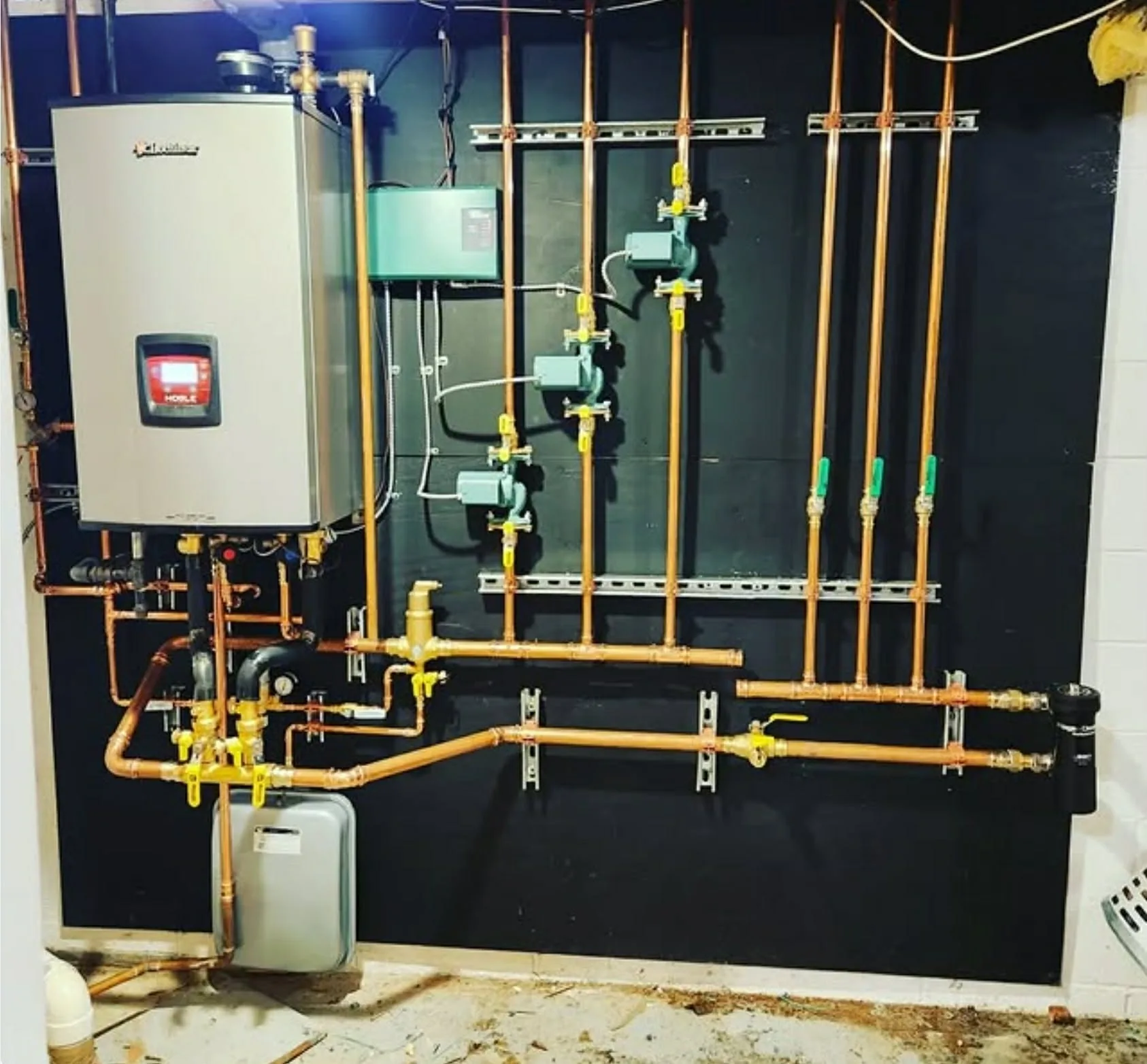
- Hot-water (hydronic) heat has no sight glass. You will see a pressure-and-temperature gauge, a circulator pump on the piping, and usually an expansion tank. Radiators or baseboard have two pipes and a small bleed screw instead of a steam vent.
If you are not sure, our guides on what a steam boiler is and what hydronic heating is have photos and a full comparison in steam boiler vs hydronic.
10 Reasons Your Boiler Runs but the House Stays Cold
Here are the causes in the order we check them, from quickest to most involved.
| Cause | System | What you notice | DIY or call? |
|---|---|---|---|
| Thermostat or batteries | Both | Display blank, wrong mode, or set too low | DIY |
| Power or emergency switch off | Both | Boiler silent, no lights | DIY check |
| Air in the system | Hot water | Radiators cold at the top, gurgling | DIY bleed |
| Low pressure | Hot water | Gauge under about 12 PSI cold | Call if it keeps dropping |
| Failed circulator pump | Hot water | Boiler hot, pipes cold a few feet away | Call |
| Stuck zone valve | Hot water | One zone cold, others fine | Call |
| Low water / low-water cutoff | Steam | Water low in sight glass, burner off | Careful DIY or call |
| Clogged radiator air vents | Steam | Some radiators cold, others hot | DIY swap |
| Blocked condensate drain | High-efficiency | Error code, boiler locks out in a cold snap | Call |
| Ignition or burner fault | Both | Repeated tries to light, lockout light | Call |
1. The Thermostat Is Not Calling for Heat
It sounds too simple, but a large share of winter "no heat" calls come down to the thermostat. Dead batteries, a setting switched to "cool" or "off" during the summer, a schedule that drops the temperature overnight, or a smart thermostat that lost Wi-Fi and fell back to a default. Check that it is set to heat, raise it five degrees above room temperature, and listen. If the boiler fires within a minute or two, the boiler was never the problem.
2. The Boiler Has No Power
Most boilers have a red emergency switch, often at the top of the basement stairs or on the wall near the boiler, and it looks exactly like a light switch. People switch it off by accident constantly. Check that switch, check the service switch on the boiler, and check the breaker. If the boiler is completely silent with no lights on its control board, power is the first suspect.
3. Air Trapped in a Hot-Water System
Air is the most common reason a hydronic radiator is warm at the bottom and cold at the top, or a baseboard loop is cold while the boiler is hot. You will often hear gurgling or trickling in the pipes. With the system running, open the bleed screw at the top of each cold radiator with a radiator key or flat screwdriver, holding a rag underneath. Let it hiss until water comes out steadily, then close it. Start on the lowest floor and work up. Bleeding releases water, so check the pressure gauge afterwards.
4. Low System Pressure
A hot-water system needs enough pressure to push water up to the highest radiator. Cold, most residential systems sit around 12 to 15 PSI, and the reading rises as the water heats. If your gauge is well below that, the upper floors go cold first. Many systems have an automatic fill valve that tops this up. If yours does not, or the pressure keeps dropping after you bleed, the system is losing water somewhere. That is a leak, a failing relief valve, or a waterlogged expansion tank, and it needs a technician. Never add water past the normal range. The relief valve opens at about 30 PSI for a reason.
5. A Failed Circulator Pump
The circulator is the pump that moves hot water from the boiler to the radiators. When it fails, the boiler heats its own water to temperature and shuts off, while the rest of the house stays cold. The giveaway is a boiler that is hot to the touch while the supply pipe goes cool a few feet away. Sometimes the pump hums but does not turn, and sometimes it is silent. Circulator replacement is a routine repair, but it means draining part of the system and working with live wiring, so it belongs with a licensed technician.
6. A Stuck Zone Valve
If you have more than one thermostat, each zone is usually controlled by a zone valve or its own circulator. When one zone is cold and the others are fine, a stuck zone valve or a failed valve motor is the usual cause. Some valves have a manual lever you can open to get emergency heat until a repair. It is worth asking about on the phone before the visit.
7. Low Water in a Steam Boiler
A steam boiler needs water in the sight glass, usually around half full when cold. If the water level drops too far, the low-water cutoff shuts the burner off to protect the boiler, so the boiler looks "on" but never makes steam. Steam boilers lose a little water as steam escapes through vents, and many older systems need water added by hand. If the level is low and the boiler is cold, the manufacturer's fill procedure applies. Never add cold water to a hot, empty steam boiler, because the thermal shock can crack the cast iron. If you are not sure, or you are adding water every few days, call. Constant water loss points to a leak in the return piping, often underground in older homes.
8. Clogged Steam Radiator Vents
On a one-pipe steam system, each radiator has an air vent that lets air out so steam can get in. When the vent clogs with mineral scale or paint, that radiator stays cold while others heat up. Replacing a steam vent is one of the few genuinely easy DIY fixes. Unscrew the old one when the system is cool and screw in a new vent of the same type. Also check that the radiator valve is fully open. On one-pipe steam, a half-closed valve traps condensate and causes banging and cold radiators.
9. A Blocked or Frozen Condensate Line
High-efficiency condensing boilers produce acidic condensate water that drains through a small plastic line. If that line clogs, or freezes where it runs outside or through a cold space during an arctic stretch, the boiler shuts down and shows an error code. This is one of the most common causes of a sudden lockout on the coldest night of the year. The fix is clearing and protecting the line, plus making sure the condensate neutralizer is not blocked.
10. An Ignition or Burner Fault
If the boiler tries to light, fails, and shows a lockout or flame-failure light, the problem is in ignition. That could be a dirty flame sensor, a failed igniter, a pilot or thermocouple issue on older units, a gas valve, or a venting safety switch. Pressing reset once is reasonable. Pressing it over and over is not, because unburned gas can build up in the combustion chamber. If it locks out twice, stop and call.
What You Can Safely Do While You Wait
If the house is getting cold and help is on the way, a few steps protect the house and the people in it.
- Keep cabinet doors open under sinks on exterior walls so room heat reaches the pipes.
- Let a cold tap drip on outside walls. Moving water is much harder to freeze. Our guide to what to do about frozen pipes covers it in detail.
- Use space heaters carefully, away from curtains and bedding, plugged straight into the wall, never with an extension cord, and never left running unattended.
- Never use a gas oven or grill for heat. That is a carbon monoxide hazard.
- Know where your main water shut-off is, in case a pipe freezes and splits. See how to shut off your water main.
When a No-Heat Call Is an Emergency
A cold house in October is an inconvenience. A cold house in January, with temperatures in the teens, is an emergency. Pipes can freeze within hours in an unheated house, and the damage from a burst line usually costs far more than the boiler repair. Treat it as urgent if:
- Outside temperatures are near or below freezing and the house is dropping fast.
- An infant, an older person, or anyone with a medical condition lives in the home.
- You see water on the floor around the boiler or hear water running in the walls.
- The boiler locks out repeatedly, or you smell gas or exhaust.
We answer 24 hours a day, Sunday through Friday, and we are closed Saturday. If a no-heat call comes in when we cannot be there, we will tell you plainly and talk you through protecting the house until we can.
What a No-Heat Repair Costs in NJ
Most no-heat repairs in northern New Jersey run roughly $300 to $1,200 or more, depending on the part and the system. A thermostat, flame sensor, or vent is at the low end. A circulator pump, zone valve, or ignition control is in the middle. A cracked section on a cast-iron boiler, a failed heat exchanger, or a leaking underground steam return sits at the top, and sometimes replacement makes more sense. Those are typical NJ market ranges, not a sight-unseen quote. Our emergency plumber cost guide explains after-hours pricing honestly, and our boiler replacement cost guide covers the numbers if your boiler is near the end of its life.
Repair or Replace an Old Boiler?
Cast-iron boilers can last 20 to 30 years or more with care, and we see plenty of 1960s steam boilers still working in Montclair and West Orange basements. Age alone is not a reason to replace. Repeated no-heat calls, water leaking from the boiler sections, rising fuel bills, and parts that are no longer made are. If you are weighing it up, rebates through the NJ Clean Energy program can take real money off a high-efficiency replacement. We will give you the honest math either way.
Prevent the Next No-Heat Call
Most mid-winter breakdowns could have been caught in an autumn check. A yearly service cleans the burner and flame sensor, checks the venting and safety controls, tests the low-water cutoff on steam boilers, checks pressure and the expansion tank on hot-water systems, and finds small leaks before they become a cold house. If you would rather not think about it, our maintenance contracts put it on the calendar for you.
FAQ
Frequently asked questions
24-hour, Sun–Fri availability
Not seeing your question? Call or text and a licensed plumber will talk it through, no answering service run-around.
Call or Text (908) 376-9159The most common causes are air trapped in a hot-water system, low system pressure, a failed circulator pump, a stuck zone valve, or a thermostat that is not calling for heat. On steam systems, low water in the sight glass or clogged radiator air vents are the usual suspects. Bleeding radiators and checking the thermostat are safe first steps. Pump, valve, and ignition faults need a licensed technician.
Keep reading
More NJ plumbing & heating guides
What Is Backflow Testing? NJ Rules Explained
Backflow testing explained for NJ. Who must test, the annual NJDEP mandate, RPZ/DCVA, and the Certificate of Compliance. Call (908) 376-9159.
Read the guide
Frozen Pipe? What to Do Right Now
Frozen pipe? Step-by-step on what to do right now to prevent a burst, and when to call a 24hr Sun-Fri NJ plumber. Call (908) 376-9159.
Should You Repair or Replace Your Water Heater?
When to repair vs replace a water heater in NJ, age, cost and safety rules of thumb from a licensed plumber. Call (908) 376-9159.